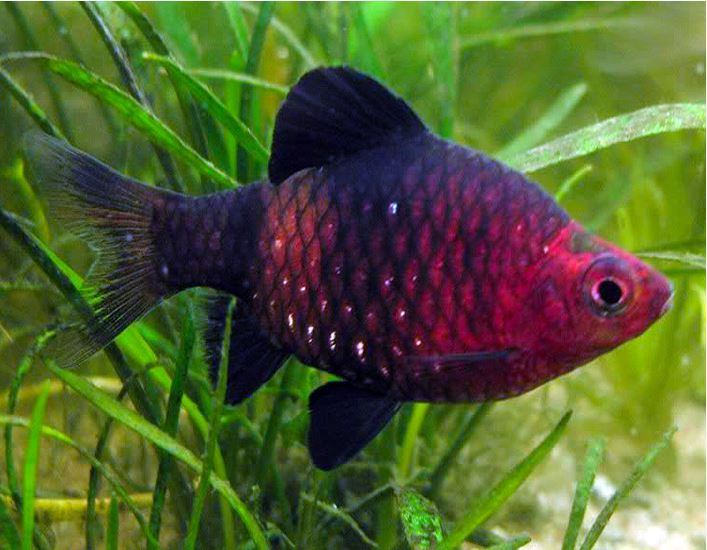
Black Ruby Barb
The Black Ruby Barb (Pethia nigrofasciata), also known as the Purple head Barb, is a stunning, peaceful freshwater fish endemic to the forested streams of Sri Lanka. It is widely prized in the aquarium hobby for the dramatic color transformation seen in mature males, which turn from a simple yellowish gray with black stripes into a deep, glowing ruby red or burgundy with a purple-black head
Basic Information
Identification & Characteristics
Identification
Identification of the Black Ruby Barb (Pethia nigrofasciata) can be challenging because their appearance shifts dramatically based on age, sex, and mood.
Profile: They have a classic high-backed, deep-bodied shape typical of barbs, similar to a Tiger Barb but slightly more compact.
No Barbels: Unlike many other barb species, Black Ruby Barbs do not have barbels (the whisker-like feelers near the mouth)
Sexual Dimorphism
Distinguishing between males and females becomes easiest as they reach maturity, particularly during spawning cycles.
Males: Coloration: Generally smaller and slimmer than females. When dominant or breeding, they turn a deep, smoky black with a glowing ruby-red or purple-red head and underbelly. Fins: Possess almost entirely jet-black fins (dorsal, anal, and pelvic), which are much darker than those of females.
Females: Coloration: Retain a paler, tan, or yellowish-gray body throughout their lives, marked by 3�4 vertical black bands. Shape: Noticeably larger and rounder in the abdomen, especially when carrying eggs. Their fins are typically clear or pale with dark bases rather than solid black.
Behaviour Details
Generally peaceful and suitable for community tanks with other active, robust species like Tetras, Rasboras, and Corydoras. Avoid slow-moving or long-finned fish, as they may occasionally nip fins.
Water Parameters
Reproduction
Breeding is relatively straightforward for hobbyists. They are egg-scatterers that often spawn in the morning. A separate breeding tank with fine-leaved plants or a spawning mop is recommended, as the parents may eat the eggs if left together.
Distribution & Origin
Native Origin
In the wild, Black Ruby Barbs are currently listed as vulnerable due to deforestation and over-collection for the aquarium trade. Consequently, the export of wild-caught specimens from Sri Lanka is prohibited, and most fish available for purchase today are captive-bred.
World Distribution
The species has a very restricted natural range, though it is now widely available globally due to captive breeding.
Photo Gallery